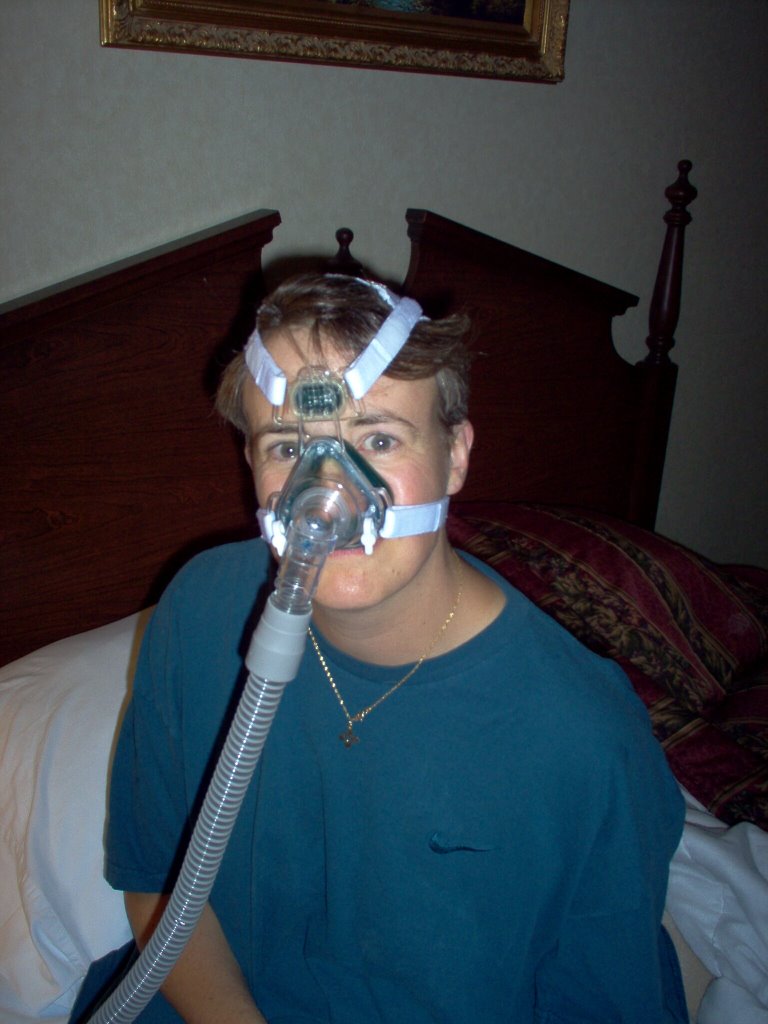
Here's one of the pictures Inez took of me with Ricky; she's posted about my visit to Iowa on her own blog. I'm still hoping she'll send me a photo of the mutilated toothbrush, too.
This seems like a suitable image to introduce my homily for the Feast of St. Francis. This is definitely one of my more lightweight efforts, but hey: fluffy fits the occasion, and with all that barking going on outside, it wouldn't be fair to ask the congregation to focus on a heavy topic.
The Gospel's Matthew 11:25-30, although I don't talk about it much.
* * *
Today we celebrate the Feast of St. Francis of Assisi, the thirteenth-century friar, groomed for prosperity by his wealthy merchant father, who instead embraced poverty. Like many other parishes, we have adopted the tradition of blessing the animals on the Feast of St. Francis, which is why you’ll find our courtyard milling with creatures of all kinds. Dogs and cats are always the most numerous visitors, but over the years, our clergy have blessed pet birds, fish, snakes, lizards, turtles, and many other species.
The Blessing of the Animals is a celebration of the amazing variety of God’s creation, and it reminds us that we’re part of a web of life far larger than our merely human households and communities. We perform this blessing on the Feast of St. Francis, the patron saint of ecologists, because he considered non-human animals his family. Francis gave one of his most famous sermons after seeing a flock of birds in a tree. According to the friar who recorded the incident, Francis ran towards the birds, “humbly begged them to listen to the word of God,” and delivered this sermon:
My brothers, birds, you should praise your Creator very much and always love him; he gave you feathers to clothe you, wings so that you can fly, and whatever else was necessary for you. God made you noble among his creatures, and he gave you a home in the purity of the air; though you neither sow nor reap, he nevertheless protects and governs you without any solicitude on your part.Francis’ biographer goes on to record that this event was a turning point for Francis. “He began to blame himself for negligence in not having preached to the birds before . . . from that day on, he solicitously admonished the birds, all animals and reptiles, and even creatures that have no feeling, to praise and love their Creator.”
And so, because this is the day when we try to follow the blessed Saint Francis, here is my own message -- although it’s really more of a letter than a sermon -- to the furred, feathered and finned flock of creatures in our courtyard.
To our Brother Dogs and Sister Cats, to our Cousin Birds and Turtles and Fish, and to all the beloved beasts who grace our hearts and homes: Grace to you and peace from God our Father and the Lord Jesus Christ. The humans who love you have brought you here today to bless you, to remind ourselves of your place in God’s creation. Some of you consider this a joyous adventure full of wonderful new sounds and smells. Some of you would clearly rather be home, although at least you aren’t at the vet’s office. Some of you, when our priests stretch out their hands to bless you, delight in being patted, while others would really be happier if the hands were offering yummy treats.
We’ve brought you here today to bless you, but also to tell you that we’ve gotten a lot of things wrong over the years. Humans are very new animals, and the more we learn, the more we realize that you’ve always known much more, and done much more, than we ever gave you credit for. Saint Francis loved birds, but he was wrong when he told them that they neither sowed nor reaped. Since Francis’ time, we humans have learned how much birds and other wild animals help the work of pollination, spreading seeds so that plants and flowers can grow. We’ve learned to admire the industry of honeybees who gather pollen, and of birds and other creatures who forage ceaselessly for food, or for material to build their nests. Last year, many of us were enthralled by a movie about penguins marching hundreds of miles to lay and hatch their eggs in howlingly inhospitable conditions.
Some of you have worked for humans as long as humans have existed. Horses, oxen, and sheepherding dogs have made much of our own work possible. Animals of all kinds have fed us, clothed us, and carried us and our belongings where we needed to go. Even now, when so much of our work is done by machines, some tasks are still best accomplished by four-footed workers. Dogs use their keen noses to rescue us after bombings and avalanches, and can detect the presence of everything from explosives to cancer. They assist and guide those of us who cannot see or hear. My friend Nickie, who is both blind and suffering from a very painful condition in one foot, reports that her guide dog is so sensitive to her needs that if she is hurting and tired and asks him to take her to the stairs, he’ll lead her to an elevator instead.
We humans are starting to understand how important you other animals are to our health and comfort. We’ve learned that pets make us less lonely, and may even help us live longer. We’ve begun to use therapy animals in hospitals and nursing homes, because humans who won’t respond to another person will often open up to the affection offered by a dog or a cat. We’ve learned that when we need to put some of our fellow humans in giant cages called prisons, because they’ve done bad things, having you there keeps them calmer and happier. Cats in prisons don't judge the people who pet them, and many prisoners now help train guide dogs. This work gives both prisoners and puppies someone to love, and allows both to be useful.
You teach all of us about unconditional love. Sometimes I wonder if you aren’t actually little pieces of God wrapped in fur -- or feathers or fins or scales -- who come down to Earth, as Jesus did, to show us what’s important. In today’s Gospel reading, Jesus says, “I thank you, Father, Lord of heaven and earth, because you have hidden these things from the wise and intelligent and have revealed them to infants.” In one of our human languages, the word “infant” literally means “non-speaking.” Like human infants, most of you can’t produce words that we understand, but that doesn’t mean that you don’t communicate. Like our own young, you teach us to love, and you teach us to accept love, and you’re very good at making your needs known. We know when you’re hungry and when you’re tired; we learn to recognize when you’re ill. We just wish that we were better at understanding you, so we could make you happier. And, like very young humans, you know many things that supposedly wiser people have forgotten and need to learn again: how to live in the moment, how to enjoy simple things, how to play.
Eight centuries ago, St. Francis urged all of you to praise and love God, but I suspect that here, too, you could give us lessons. Anyone who has watched a dog frolicking in the snow has witnessed pure joy and praise. Last spring, my husband and I went to Hawaii, where we saw humpback whales: mothers and calves who, based on their ecstatic leaps out of the water, were surely delighting in God’s creation. I once read a story about a woman who came downstairs one Christmas morning to discover that her cat had left a dead mouse among the camels and wise men in the creche. The cat, she told her friends, must have brought the finest gift it could imagine to the Baby Jesus. A few years ago, my husband and I came downstairs on Christmas Eve to find that one of our own cats had left a baby bird lying neatly at the foot of the stairs. Our cat was deeply hurt by our distressed response to this Christmas gift, but I’m sure that God looked into the heart of the giver, and understood.
So when we bless you, please understand that we’re really thanking you for everything you’ve done to bless us. Please be patient with us as we continue to learn more about you, about ourselves, and about the astonishing world God has given all of us. And please continue to teach us how to praise our Creator very much, and always love him.