This week's hospital shift went much better than last week's. This is probably mostly because I didn't do the nursing-home service this afternoon, so I had time to swim, which -- in addition to being good exercise -- is an important centering and prayer discipline for me.
Gary's suggested that on my nursing-home Sundays, maybe I should skip church in the morning so I'll have time to exercise. I think that's throwing out the baby with the bathwater, but I might go to the early service to give myself time to get to the pool (that is, if I'm not preaching and required to be at both services). On the other hand, having to be anywhere at eight in the morning means I'll be shot by five in the afternoon, so that's probably not the best idea either.
Hmmmm. I'm going to have to work on this. At least the nursing-home service is only once a month!
Anyway, whether it was because of my swim or a different mix of patients or who knows what else, today's shift was very satisfying. I saw a patient from last week, someone I'd helped with a social-service issue; I don't often get to hear how things have gone for people, so it was nice to have a follow-up visit (although of course both the patient and I would have been happier if a second ER trip hadn't been necessary). A lot of folks requested prayer tonight. I got to spend time with an adorable baby who glommed onto me and merrily yanked on my necklace, my earrings, my glasses, and my ID badge, and then snuggled sleepily into my shoulder. I had pleasant interactions with staff, including one nurse who came up with a mock-scientific, straight-faced explanation for why I simply had to have a Milky Way bar after I'd already eaten a bag of almonds. "Almonds are very healthy, and the chocolate will help you metabolize them better."
I worked a little longer than I usually do, and when I went to take myself off the board, sure enough, I'd been erased already! But this time I gave the charge nurse a hard time about it. "Yeah, I go to take myself off the board and I'm already gone, and that just makes me feel so loved and wanted, you know?"
She was laughing. "I took you off. I take the doctors off, too. Don't take it personally." (Ah, yes, the ER mantra! "Don't take it personally!")
So it was one of the shifts when I felt like I belonged there, which means that it's one of the shifts I'll hang onto when things aren't going so well. This one was a keeper.
Keepers are important. They're what keep me going back.
Sunday, September 17, 2006


Saturday, September 16, 2006
The Masked Crusader!
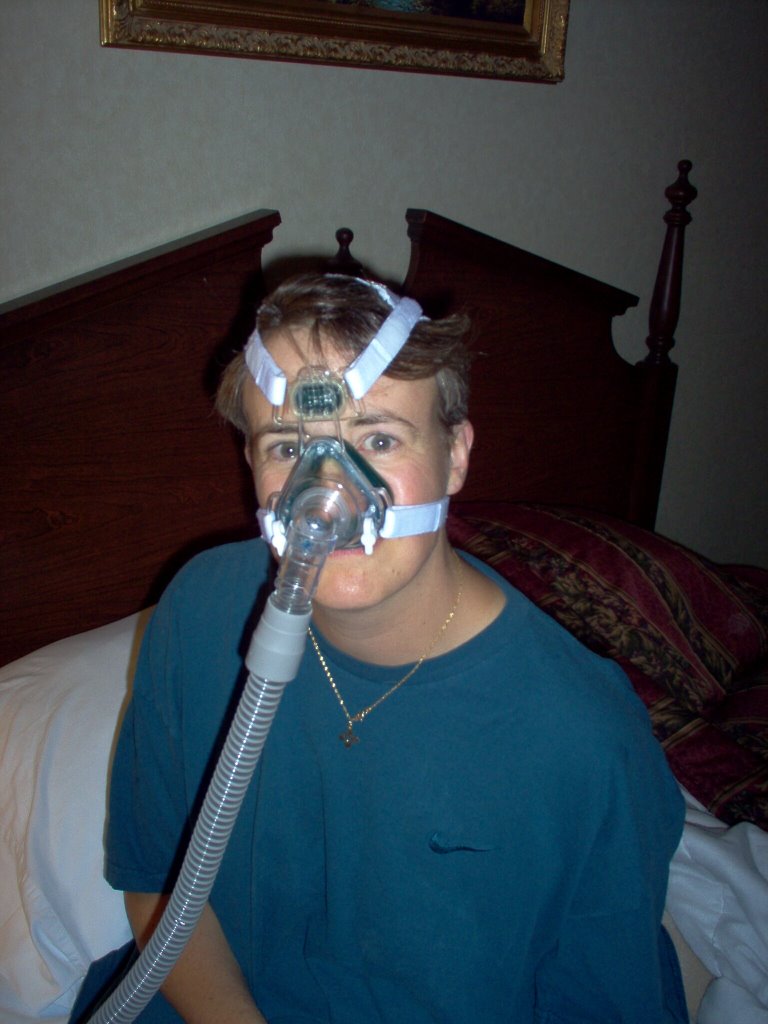 Blog readers! Do you suffer from constant fatigue? Do you doze off during the day? Do significant others and housepets refuse to sleep in the same room with you, because you snore loudly enough to shake walls and rattle windows? Do people who've heard you snore report a characteristic pattern of increasingly loud snoring, ending in a choking gasp?
If you answered "yes" to these questions, then you, too, could be suffering from a sleep disorder!
The best-known sleep disorder is apnea, a potentially life-threatening condition in which patients stop breathing during their sleep. The brain alerts the body to wake up and breathe; the body dutifully obeys, interrupting sleep. As a result, the patient will be exhausted in the morning, but won't remember ever having woken up. In addition to creating sleep deprivation, a serious condition all by itself, apnea greatly increases the risk of heart attack and stroke.
Gary and I learned about apnea when his mom was diagnosed and started using CPAP (Continuous Positive Airway Pressure), a machine that blows pressurized air through a mask into your nose so your airway will remain open and you'll keep breathing. Because we were educated about sleep disorders, we had a good hunch about what was going on several years later, when I began suffering from severe daytime fatigue, combined with increasingly dramatic snoring at night.
Based on my symptoms and Gary's description of my snoring, my doctor was convinced I had apnea. When I went for my sleep test, it turned out that I didn't have apnea; I have a similar but less serious condition called Upper Airway Resistance Syndrome (UARS). My airway narrows when I sleep, but doesn't close completely. My sleep is still interrupted by "wake up!" messages from my brain -- an average of sixteen times an hour, according to the sleep test -- but I don't stop breathing. This is a Good Thing.
The treatment is the same, though. Yes, that's a picture of me in my CPAP mask at the beginning of this post. My sister took the photo two years ago during a summer roadtrip, during which she memorably described the CPAP headgear as looking "like a cross between a vacuum cleaner and a jock strap." Pretty glamorous, huh?
But I feel so much better on CPAP that I've now become an absolute evangelist for sleep testing. I recently exhorted a friend to have it done; it turns out that she has severe apnea, and in the month or so that she's been on CPAP, her blood pressure has gone down to its healthiest level in years.
Visiting my father a year or so ago, I became convinced by his snoring, and his daytime fatigue, that he had apnea and should be tested. He talked to his doctor at the VA, but because he couldn't describe his own symptoms very well (we can't hear ourselves snore!), they didn't give him the test. So this summer, I wrote a letter to his doctors describing his snoring.
It worked. They gave him the sleep test. He called me a week ago to report that he indeed has apnea; we were both very excited by this news, because starting on CPAP could make him feel so much better. Because the VA moves slowly, he has to wait a while for the equipment, but he's feeling hopeful about the outcome.
Yesterday, he called me with the official results of his sleep test. According to the VA, 5-15 sleep interruptions per hour indicate a mild disorder; 16-30 indicate a moderate disorder, and anything over 30 is severe. My father had an average of fifty interruptions an hour. And he's already had heart trouble and one mild stroke.
I can't tell you how happy I am that I said something!
So if you have these symptoms, or if someone you love has these symptoms, please, please, please look into sleep testing!
Q: If I think I have a sleep disorder, what should I do?
A: Consult your doctor. The first step will probably be bloodwork to rule out other possible causes of fatigue, like thyroid problems. If everything else checks out, you'll be sent for a consultation with a pulmonologist. Bring a significant other with you! If you don't have a significant other, set up a recorder next to your bed so you'll have a tape of your own snoring. As my father's case illustrates, it's very important for the doctor to hear the testimony of someone who's actually heard you snore.
Q: What's the sleep test like?
A: Oh, it's very entertaining. You show up a few hours before bedtime at a lab with a bunch of bedrooms. Techs spend forty-five minutes or so hooking you up to so many wires, monitors, belts and microphones that you look like someone getting ready to go up in the space shuttle. (Really, I wish I had a picture of myself wired for the sleep test.) And then they tell you to go to sleep.
All the wires and monitors are pretty lightweight, and the labs invest in good beds, but many people still have trouble sleeping. Part of the problem is that sleep labs, by definition, are filled with people who snore really loudly. Before my test, I was told that if I showed signs of apnea, I'd be woken up halfway through the night to be fitted with CPAP. At that point, I desperately wanted CPAP, so I lay awake, listening to the building vibrate from other people's snoring. Periodically somebody's snoring would stop, which meant that person had been woken up and fitted with CPAP. I finally dozed off . . . and was woken up and fitted with CPAP, to my great joy!
And then I woke up and discovered that I wasn't wearing CPAP. I'd never been wearing CPAP. I wanted CPAP so badly that I'd dreamed about getting it. I went home literally weeping with exhaustion and frustration. Luckily, it turned out that all the wires and monitors had picked up proof that I had UARS, so I got my CPAP anyway.
Q: But isn't CPAP, well, uncomfortable?
A: It can be. The biggest challenge is finding the right headgear, but there are lots of different kinds -- ranging from simple nasal cannula, like oxygen tubing only thicker, to full-face masks -- so you'll have a wide range of choices. If the first thing you try doesn't work, don't give up! Your medical provider will work with you on this.
I have a very small head, and wound up having to wear a pediatric mask. It took me about a month to figure that out and to find headgear that worked for me. During that month, I was frustrated and miserable. Since then, I've been very happy.
Q: But isn't having to deal with the machine a pain in the neck?
A: No, not really. It's quite small, and very quiet and easy to clean, and there are even battery-powered models for camping. Plane travel's a bit of a hassle, because the machine has to be carry-on. (Do not put your CPAP in checked luggage, because it will get thrown around and will break. I'm speaking from experience.) Also, CPAP machines often have to go through special tests at airports to make sure they aren't bombs. But the folks who work at security see hundreds of these machines a day, so they're friendly and sympathetic. They don't really think CPAP machines might be bombs, but their bosses do. The screeners are just doing their jobs. And you may have a chance to encourage your sleepy security screener, whose wife complains about his snoring, to go get his very own sleep test. You could be saving a life!
Q: Yeah, yeah, yeah. But, come on . . . you know! Doesn't it, doesn't it interfere with -- oh, you know! Doesn't your husband hate it that you're wearing this thing that looks like a cross between a vacuum cleaner and a jock strap? And doesn't that, um, ah, have a negative effect on your marriage?
A: Oh! So that's what you really wanted to know!
No, CPAP does not interfere with recreational intimacy. I wear CPAP when I'm asleep. My husband and I engage in recreational intimacy when we're awake. Sleep deprivation has a far more negative effect on recreational intimacy than CPAP does.
Gary loves my CPAP, because I don't snore any more.
Or as the sign in my pulmonologist's office puts it:
"Laugh, and the world laughs with you.
Snore, and you sleep alone."
So, all you snorers, what are you waiting for? Go get that sleep test!
Friday, September 15, 2006
Random Acts of Love
On September 8, a Portland ER nurse named Susan Kuhnhausen returned home from work to discover an intruder with a hammer in her house. She proceeded to strangle him with her bare hands. I learned about this from GruntDoc. Moral of the story: Don't mess with emergency nurses!
But it turns out there's more. The intruder had been hired by Kuhnhausen's ex-husband to kill her. GruntDoc reports on the story here, and includes a link to an Oregonian article that includes Susan Kuhnhausen's new voicemail message:
"I'm not able to answer all the calls that I've received. I'm being comforted by your concern and your support. I want you to know that our lives are all at risk for random acts, but more likely random acts of love will come your way than random acts of violence.
"I would encourage you all to follow guidelines for home security and personal safety and security. I love my neighborhood. This is my home. I feel safe here. Thank you all so much."
We're all at risk for random acts of love: how wonderful is that?
And how true!
Thursday, September 14, 2006
Carnival of Hope: Volume 1, Number 1
 Welcome to the first Carnival of Hope! I'd like to thank everyone who sent me posts, whether or not I used them. Reading through all the submissions was a very heartening experience for me, and I hope you'll have the same reaction to the final edition!
I'm still getting the hang of formatting, and putting the carnival together was much harder than I expected, so this first go may be rather rough. Please bear with me as I learn. If anyone out there with lots of carnival experience -- that would be you, Kim! -- has advice for me, please share it. In the meantime, I'm delighted to have found this photograph of a flower pushing through a concrete sidewalk; I plan to use it as the Carnival of Hope logo from now on. It reminds me that seemingly small things can possess enormous power.
Nickie from Nickie's Nook knows something about pushing through barriers. She reminds us of the power of persistence (and prayer) in her very moving post about learning to work with a guide dog, Never Forsaken. Facing yet another physical challenge, this one involving chronic pain, she discovers the healing effects of Just A Few Words.
The supportive presence of friends can indeed make the difference between a lousy day and a great one, as Karma explains in Get By With A Little Help From My Friends Part II from JewBuQuest: From Abuse to Happiness. Your Faithful Blog-Carnival Editor reveals the dark roots of her Disgusting Cheerfulness, and advocates small steps that can have big effects on chronic depression, in Making a List. Checking it Twice. And Keagirl, the blogging urologist of UroStream, likewise attests to the great power of simple steps -- this time surgical ones -- in Happy day.
Elsewhere in the hospital, ER nurse Kim of Emergiblog offers us a sobering look at the importance of hope to family members in Where There Is Life, There Is Hope. The end of hope, Kim says, is the beginning of shock and grief: a terrible moment, although it's one we will all experience at one time or another.
Certainly most of us cling to hope as long as possible, especially when it comes to the illnesses of those we love. None of us would choose to suffer, or to watch those we love suffering. And yet the compassion created by shared pain can overcome seemingly insurmountable distances and "bring the world closer," as Amanda of Imagine Bright Futures tells us in her beautiful post Empathy.
If you're looking for a lighter way to make the world seem like "a smaller, friendlier place," Suite 101's Jennifer Miner recommends that you join her in Geocaching with My Portable GPS. But if you're geocaching and encounter a sign that says, "Not a Through Road," have faith and don't turn back! That's what Will Shetterly of It's All One Thing learned from Today's Inspirational Message.
Yet another way of bringing farflung people and places closer is the goal of the National Geographic All Roads Film Project, "showcasing breakthrough film and still photography from indigenous and under represented minority cultures around the globe." Thanks to Lee of Chrysalis Dreams for sending me that link! And closer to home, Lee describes the comfort and wonder of ordinary, everyday routines in her lovely post Comics and Ritual.
How do we cope when our everyday peace is shattered, when our sense of safety is broken? Each of us can decide to respond with vengeance -- or with love. I have to admit that I've avoided most of the 9/11 anniversary tributes, because they're too painful. But I can only find hope when I read about a mother whose message to her firefighter son, killed at the World Trade Center, is, "We know you're telling us to smile more." Tracy Coenen of FRAUDfiles Fraud Blog shares this story in A tribute to John Patrick Tierney. "This was my contribution to the 2,996 Tribute, in which one blogger honored each of the the 2,996 victims of 9/11."
Post-9/11, Violeta's proposal at Questallia to make each day Forgiveness Day couldn't be more timely.
And yet forgiveness can be very hard-won. Sometimes it seems impossible. And sometimes our ability to forgive depends on whether we consider ourselves insiders or outsiders. Ali Eteraz, a progressive Muslim living in Europe, tells us, "That is the solution to fighting hate: make people feel like they are insiders." Be forewarned: his essay on this subject is challenging, and the comments on his post are even more so. I almost didn't include this piece, because so much of it seems to participate in the very us/them, politically polarized rhetoric I want Carnival of Hope to avoid. I'm still nervous about whether I'm doing the right thing by putting it in (and I expect that some of my readers will have strong opinions on the subject!). But reading it made me feel like that flower pushing through the sidewalk; when I kept going, I arrived at a very thought-provoking story about eleven-year-old Ali, an outsider, being defended against school bullies by two other kids who said, "We aren't all like that." I wish the defense hadn't been as brutal as the assault, but I certainly can't argue with Ali's conclusion: "The fundamental human need is one of recognition." If you haven't been scared away by this introduction, then, read The Fanatics, Not Foreign Policy posted at Unwilling Self-Negation.
Returning to gentler territory, we find Elias, an Australian teacher who grew up in the war-torn Middle East, reflecting on whether his childhood experiences have made him Grateful for Every Day? And elsewhere on Elias' blog, Ramblings of an Australian Teacher, we join him in rejoicing in the power of education, which holds out one of humanity's brightest hopes for the future, in Teaching is a Privilege.
And that concludes our first edition. The second one will be posted on Friday, October 13, surely a good day for a Carnival of Hope! Please send your posts directly to SusanPal(at)aol(dot)com, or submit by clicking on the BlogCarnival button on my sidebar. The deadline is 5:00 Pacific Time, Thursday, October 12.
Thank you for reading, and may all your hidden flowers tunnel their way towards the light!
Bits o' Good News!
So I'm feeling Disgustingly Cheerful again this morning, although it may not last long. (Among other things, I've now embarked on the Excellent Adventure known as perimenopause, which may make my moods even flakier than usual.) Here are some reasons why:
* On Tuesday I handed back my first set of freshman comp papers. I'd expected to give them back today. I told the students, "I've been teaching for almost fifteen years, and this is the first time I've ever gotten papers graded more quickly than I expected to, and that's because they were so much fun to read." Go, frosh!
* Yesterday, the copy-edited manuscript of The Fate of Mice arrived, further proof that it's really going to be a book! Woo-hoo! Oh, by the way, if you're a Famous Writer reading this -- or more famous than I am, anyway, which doesn't take much -- and you'd be willing to give a blurb on the book, could you please contact me privately? We have a couple of blurbs, but we're looking for more. I hate asking people to do this, but it's a necessary part of the process.
* Last night I discovered that I'd gotten a bunch of Carnival of Hope submissions (deadline: 5:00 PM today!) that I hadn't known about. BlogCarnival was supposed to e-mail them to me, but they hadn't come through, even though the site has my correct e-mail address. So I e-mailed the support team to describe the problem, but I figured nothing would happen, because I've had lousy luck with the support teams at websites. I e-mailed TTLB three times to see why I wasn't showing up on their site, and they never got back to me; the same thing has happened a few other places. But this morning, I had several e-mails from BlogCarnival, and they fixed the problem, and the person who did that, Denise, also wrote a really nice note about my carnival. Hey, how's that for prompt, efficient, friendly service? BlogCarnival gets an A+!
So tomorrow, the first Carnival of Hope should be posted, although I expect to be up very late tonight trying to get it organized and written. A new blogging challenge: this is what I live for.
Everybody needs a hobby!
Wednesday, September 13, 2006
Pink Ladies
We now have documented medical proof that chaplaincy controversies are harmful to your health!
This morning I had an appointment with my primary-care physician for routine medication follow-up. Before I left, I read this post on Marshall's blog. The post is a continuation of his series about the place of volunteers in chaplaincy, and includes the following comment from Melvin Ray, Director of Pastoral Care for the Hunt Memorial Hospital District in Greenville, Texas:
A frequent visitor to the ED where I volunteer recently told me, "You're a wonderful chaplain! I hope you never leave!" Chaplain Ray would presumably tell this patient that she's wrong and that I have no business even talking to her, or that if I do talk to her, I should identify myself as a "volunteer minister" rather than as a "volunteer chaplain."
Hey, whatever. If a mere change in wording will make you feel less threatened, I'm happy to oblige. (I would like to point out that I've ministered to non-believers, too, many of whom gave every indication of being genuinely grateful.) But the label "Pink Ladies" is sexist, condescending, and generally unbecoming a chaplain.
Yes, most volunteers in my hospital are women, but some are men.
The volunteer coordinators, who are likewise both female and male, work very hard to provide training, support, and scheduling. Their jobs won't be any easier if other people in the hospital dismiss them. If Chaplain Ray is distressed that professional chaplains don't get enough pay or respect -- and one doesn't have to read far between the lines to see that subtext -- one would think he'd be especially careful not to belittle colleagues in the volunteer services department. They don't get paid enough, either.
Volunteers and volunteer coordinators take what they do very seriously. Patients take what they do very seriously. Many staff take what they do very seriously. I don't have numbers to prove this, but I strongly suspect that most hospitals couldn't function very well without their volunteers.
I don't know Chaplain Ray's religious tradition. In my tradition, baptism includes the promise to "seek and serve Christ in all persons" and to "respect the dignity of every human being." I don't believe that someone who would dismiss me as a "Pink Lady" is respecting my dignity or seeking to find the image of Christ in my life and work. For that matter, I don't believe that dismissing an entire class of people as "Pink Ladies" even begins to pass the WWJD test.
My name is Susan. I'm a unique and beloved child of God with irreplacable (and unreproducible) strengths, shortcomings, hopes, and aspirations. There is only one of me; I am as individual and complex as a snowflake or a fingerprint.
And pink is so not my color.
Okay, so all of this is swirling through my head as I drive to the doctor's office. I've brought coffee in a travel mug; the best time to see my doctor is at 8:00 a.m., because she's a really good doctor who spends more time with patients than the fifteen minutes alotted by the managed-care system, which means that if you don't grab her earliest slot, you'll wait all day. But if pink isn't my color, morning isn't my time.
So I get there, bleary-eyed, and have various measurements taken by a nice nurse.
Oxygen level: 95%. Excellent.
Blood pressure: 100/62. Excellent.
Pulse: 105. "That's a little high," the nurse says, frowning, and then sees my travel mug. "Oh, it's the coffee."
No, I don't think so. I always have 8:00 appointments with my doctor, and I always have my travel mug with me, and my pulse is usually between 70 and 90. (This is a new nurse, who doesn't know that.) So I don't think it's the coffee.
I think it's the anger over having my ministry -- and the ministries of friends and colleagues I love dearly -- trivialized by someone who's never met any of us and doesn't know diddly about what we do.
Is my pulse rate my problem? Yes, sure. Do I need to learn to calm down about this stuff? Yes, certainly. Does Chaplain Ray need to be more respectful of volunteers?
What do you think?
This morning I had an appointment with my primary-care physician for routine medication follow-up. Before I left, I read this post on Marshall's blog. The post is a continuation of his series about the place of volunteers in chaplaincy, and includes the following comment from Melvin Ray, Director of Pastoral Care for the Hunt Memorial Hospital District in Greenville, Texas:
Yes, volunteer ministers can minister to those believers who desire such help; let the “Pink Ladies” coordinate this. Chaplaincy is a documented clinical intervention accomplished by a highly trained, certified, and well paid health care professional. Chaplaincy should not be entrusted to volunteers.To be fair, I need to point out that I'm quoting this out of context; Marshall has a link to Ray's complete comment. But the part I've quoted here definitely made me see red -- or pink.
A frequent visitor to the ED where I volunteer recently told me, "You're a wonderful chaplain! I hope you never leave!" Chaplain Ray would presumably tell this patient that she's wrong and that I have no business even talking to her, or that if I do talk to her, I should identify myself as a "volunteer minister" rather than as a "volunteer chaplain."
Hey, whatever. If a mere change in wording will make you feel less threatened, I'm happy to oblige. (I would like to point out that I've ministered to non-believers, too, many of whom gave every indication of being genuinely grateful.) But the label "Pink Ladies" is sexist, condescending, and generally unbecoming a chaplain.
Yes, most volunteers in my hospital are women, but some are men.
The volunteer coordinators, who are likewise both female and male, work very hard to provide training, support, and scheduling. Their jobs won't be any easier if other people in the hospital dismiss them. If Chaplain Ray is distressed that professional chaplains don't get enough pay or respect -- and one doesn't have to read far between the lines to see that subtext -- one would think he'd be especially careful not to belittle colleagues in the volunteer services department. They don't get paid enough, either.
Volunteers and volunteer coordinators take what they do very seriously. Patients take what they do very seriously. Many staff take what they do very seriously. I don't have numbers to prove this, but I strongly suspect that most hospitals couldn't function very well without their volunteers.
I don't know Chaplain Ray's religious tradition. In my tradition, baptism includes the promise to "seek and serve Christ in all persons" and to "respect the dignity of every human being." I don't believe that someone who would dismiss me as a "Pink Lady" is respecting my dignity or seeking to find the image of Christ in my life and work. For that matter, I don't believe that dismissing an entire class of people as "Pink Ladies" even begins to pass the WWJD test.
My name is Susan. I'm a unique and beloved child of God with irreplacable (and unreproducible) strengths, shortcomings, hopes, and aspirations. There is only one of me; I am as individual and complex as a snowflake or a fingerprint.
And pink is so not my color.
Okay, so all of this is swirling through my head as I drive to the doctor's office. I've brought coffee in a travel mug; the best time to see my doctor is at 8:00 a.m., because she's a really good doctor who spends more time with patients than the fifteen minutes alotted by the managed-care system, which means that if you don't grab her earliest slot, you'll wait all day. But if pink isn't my color, morning isn't my time.
So I get there, bleary-eyed, and have various measurements taken by a nice nurse.
Oxygen level: 95%. Excellent.
Blood pressure: 100/62. Excellent.
Pulse: 105. "That's a little high," the nurse says, frowning, and then sees my travel mug. "Oh, it's the coffee."
No, I don't think so. I always have 8:00 appointments with my doctor, and I always have my travel mug with me, and my pulse is usually between 70 and 90. (This is a new nurse, who doesn't know that.) So I don't think it's the coffee.
I think it's the anger over having my ministry -- and the ministries of friends and colleagues I love dearly -- trivialized by someone who's never met any of us and doesn't know diddly about what we do.
Is my pulse rate my problem? Yes, sure. Do I need to learn to calm down about this stuff? Yes, certainly. Does Chaplain Ray need to be more respectful of volunteers?
What do you think?
Tuesday, September 12, 2006
Grand Rounds, and a Plea for Submissions
This week's edition of Grand Rounds is up at Diabetes Mine, and Amy's done a fabulous job. Thanks for the great presentation, and for including my post!
The deadline for Carnival of Hope is this Thursday at 5:00 PM Pacific Time. As of this moment, I have one -- count 'em, one -- submission, with a promise of a second.
Now, I know that my own reserves of Disgusting Cheerfulness have been a little low lately, but there has to be more hope out there than that!
Come on, all you happy shiny people (or unhappy people who've discovered small bits of brightness in unexpected places): please let me hear from you! E-mail your submissions to SusanPal(at)aol(dot)com. You can do it! We can do it! Go, team!
The posts don't have to be recent; you can send me old ones. Or links to news stories that make you feel good. Or your own recipes for how to find renewed energy and keep going.
Please?
Puh-leeeeze?
It'll be fun. Really!
Monday, September 11, 2006
Erased
No, this isn't a 9/11 post. After quite a bit of thought, I've decided to declare this blog a 9/11-free zone for the day. There's a lot I could say on the subject, but very little of it's new, and the things that are personal and unique to me are things I got into trouble for saying immediately after the event. A number of people told me that I shouldn't/couldn't/didn't have the right to be feeling what I was feeling, because I hadn't been there/wasn't one of the main victims/was a traitor for not plastering American flags all over everything I own.
I really don't want to go through that again.
I believe very firmly that 9/11 traumatized everybody. One of the ways it did that was by becoming one of those omnipresent, inescapable public events to which there's only One Right Response. None of us could get away from it, and -- at least for a few weeks right after the day itself -- there was very little room for any kind of authentic, rather than culturally scripted, response.
This is coercion, plain and simple, and too much of today is going to be more of the same. So I'm opting out, thank you. I've spoken my last words on the subject.
So now that I've gotten that out of the way, can we talk about schizophrenia?
* * *
Wait, no, back up. Yesterday ended badly, so I need to remind myself that it started well. Church was a pleasure; my visit to the assisted-living facility was a delight; I even got some good publishing news. (The long-delayed third novel is scheduled for June, and The Necessary Beggar will be out in mass-market paper in March.)
But because I'd had a busy day and hadn't had time to exercise, I arrived at the hospital tired. Sometimes it doesn't matter; sometimes the energy of a shift will burn the fatigue right out of me. Sometimes, no matter how tired I am when I get there, I wind up in The Zone, where I'm moving with the flow of the department: saying the perfect things to patients, somehow showing up at exactly the right place and time to get or give needed information, successfully juggling piles of blankets and multiple cups of water while dodging ambulance gurneys and portable X-ray machines.
Last night, I wasn't in The Zone. Last night, I was doing one of my best Inspector Clouseau impersonations: knocking into people, dropping things, forgetting names. The chaplain as bumbling idiot.
The shift wasn't a complete loss, by any means. I had at least three really solid visits with patients who were very glad to talk to me and very grateful for my help, both spiritual and practical. Two of these visits involved depression and grief issues. Because I have depression myself, this is home ground. Depressed patients tend to be very comfortable with me, because they can tell I know the territory. And I'm walking proof that they aren't going to feel that way forever, that things can get better.
Score three for Clouseau.
Enter Patient X. Patient X is kind, alert, engaged, and thoughtful. Compliments me on my jewelry. Asks for prayer. When I ask what we're praying for, names the war, the victims of 9/11, and the environment, not immediate health concerns. (This always warms my heart, although I always pray for health issues too.)
A nurse arrives. I tell Patient X I'll be back later. The next time I go back, the doctor's in there, and I overhear part of what sounds like a very lucid conversation.
I return to Patient X after the medical staff has left. We start chatting. And suddenly things go seriously south. I start getting stories about shape-shifting roommates, extraterrestrial relatives, and characters from television shows undergoing top-secret medical experimentation. And then Patient X says, "But please don't tell anyone."
My heart sinks.
For a layperson, I'm pretty well educated about mental illness, and I'm intensely sympathetic to the issue. There are very few mentally ill patients who scare me or leave me at a loss. I've talked to depressed patients, suicidal patients, bipolar patients, patients with MPD and borderline personality disorder. I've had very pleasant conversations with self-aware schizophrenics who needed to vent about how hard the illness is. I once heard a hilarious and heartbreaking rant from a patient who said, "Do you have any idea what a pain in the neck it is to be hearing these voices other people can't hear and don't want to hear about?"
But I've never figured out how to talk to patients who are actively delusional, the "Saddam Hussein is burying Swiss francs in my garden and my neighbor turns into a kangaroo who implants electrodes in my skull while I’m sleeping" crowd. I don't want to shame or abandon these patients, who are usually very lonely and isolated, but I also don't want to play along and reinforce their delusions. It doesn't help that they're almost always bright, charming, personable, and clearly starved for human contact.
I want to give them human contact, but I don't know how to do that safely. So I usually stand there, try to smile, nod until I start getting scared that I'm reinforcing their delusions just by nodding, and then beat a hasty retreat, feeling wretched.
Last night, I felt wretched. Patient X had trusted me enough to share very personal stories, and had asked me not to tell other people about them. But Patient X had also come in with a medical complaint, not for psych issues. The stories were symptoms of illness, weren’t they? Did the med staff know about this? If they didn’t, did they need to? How could I know without asking? And how could I ask while honoring X’s request for confidentiality?
I finally decided to fudge the issue by telling someone about the general tone of the stories without sharing the details.
Let's back up again. I'd arrived at the hospital worried about whether I'd have to start all over with a new set of ED staff who didn't know me. Earning staff trust and getting into their long-term memories can be a very long, difficult process. So when I showed up for the new shift, I was delighted to see a number of people I knew, including Nurse Y, someone who's referred me to a lot of patients and who’s also complimented me on my work with a number of them (including, significantly, psych patients). And Nurse Y was the appropriate person to tell about Patient X.
So I approached Nurse Y. "Excuse me, but is Patient X's medical team aware that there are major psych issues?"
Nurse Y, clearly cranky, pulls up the records. "Yep, it's schizophrenia."
"That's what I thought."
"Well, you called it, good for you." Snarkily. "You know, it's not illegal to be crazy."
Me, in shock: "Of course not! Nor should it be!"
"Crazy people get sick, too."
"Of course they do! I just -- "
"And schizophrenics can reason pretty well, when you think about it." This thrown over a shoulder as Nurse Y walks away.
I stood there, feeling about half a centimeter high. Nurse Y has watched me work for almost two years. Nurse Y, in the past, has known that I'm someone who advocates for psych patients instead of shaming them. And suddenly all of that's gone? I have to start all over again after all? I was never actually in long-term memory, or the files got erased when I switched to a different evening? And even worse, I’ve violated patient confidentiality to deliver unwanted, redundant information?
It was near the end of my shift. I was upset. I went and sat in a deserted lounge for a few minutes to calm down, and then marched back into the ED and up to Nurse Y (PITA for Christ, PITA for Christ, PITA for Christ). "I want to be clear on this. I wasn't trying to stigmatize Patient X. I was trying to make sure that Patient X got appropriate help."
"Don't worry about it, we're good." This thrown back over a shoulder as Nurse Y walks away. I don't think Nurse Y has heard me.
It's now a few minutes shy of the end of my shift, but I decide to leave a little early. I walk over to the board to remove myself from the "chaplain" box, in which I always write my name and the hours I'll be working. But it's empty. Somebody's already taken me off. I've been erased.
Now feeling thoroughly wretched, I head back to my car. On the way there, I see one of the security guards, someone who's watched me work with psych patients even more often than Nurse Y has, since he's usually one of the people guarding them. I vent. The security guard listens, looks sympathetic, makes encouraging noises. "Of course you were trying to help! Y can get like that. Don't take it personally."
When I got home last night, I had e-mail from Kim about something else, and since she's an ED nurse with psych experience, I asked her about this case. Had I done the wrong thing? Should I not have mentioned the psych symptoms? She assures me that I acted appropriately, and that the medical team needed the info. That made me feel a lot better.
But I still don't know how to talk to delusional patients. Does anyone have tips?
Sunday, September 10, 2006
All Hail Uppity Women!
 This woman appears twice in the Gospels: once in Matthew, and in today's reading from Mark. I've preached on the Matthew version, so I'm posting that homily.
I love this woman. She's the only person in the Gospels who argues with Jesus and wins, who gets him to change his mind. She's my hero.
A few years ago, I took a two-week summer course on the Gospels at GTU. The teacher was brilliant, but pretty unbearable. The class met four hours a day: his teaching style was to lecture the whole time. He only wanted to take questions or comments during breaks. About four of us -- two men and two women -- kept stubbornly raising our hands, and when he refused to let us talk, we started just calling out whatever we had to say. This clearly annoyed him no end, but we did it anyway.
One day we were doing a comparison of the Mark and Matthew passages about this woman. In Matthew, she's much more aggressive: the story happens outside rather than in a house, and she chases after Jesus and heckles him, like some crazy street lady. The teacher's point was that the Matthew version makes her ruder and less sympathetic so that Jesus' final acceptance of her will be more impressive: he's blessing this woman his audience would have despised.
During the break, I approached him and said, "Okay, she's ruder in the Matthew version, but how can she ever be unsympathetic? She's begging for healing for her sick child. She's desperate. How could anyone not sympathize with that?"
The teacher looked at me, sniffed, sneered, and said, "Well, Susan, I'm sure you don't have any trouble with obnoxious women."
*cough, cough*
No, sir. Only with obnoxious men.
On another, more serious note: I'm intensely grateful that I don't actually have to preach today, because I'm not sure how I'd tie this Gospel in with 9/11. I'd talk about Others in desperate need and compassion and healing, I guess. I'll be interested to hear what our preacher says this morning.
Last year, I preached on 9/11 and Katrina, on 9/11 itself. I may post that homily tomorrow.
Today is one of my ministry-marathon days, though: church this morning, my monthly nursing-home service in the afternoon, and then it's off to the hospital for my first Sunday shift. Wish me luck!
And without further ado, the homily.
* * *
This is the woman we heard about in today’s Gospel. This icon was painted by Robert Lentz, and I find it profoundly moving. Look at her face, her downturned eyes and furrowed forehead. Look at the weariness and worry in that face. It’s the face of someone who’s so frantic about her sick child that she’s willing to chase down strangers in the street to demand help. It’s a face many of us might prefer not to look at, because there’s too much pain there, too much fierceness. It’s the face of someone who won’t take no for an answer.
It’s important for this woman to have a face, because we never learn her name. Not here in Matthew and not in Mark, where the other version of her story appears. In Matthew she’s the Canaanite woman; in Mark, she’s the Syro-Phoenician woman. We know her only by her label, her nationality, her otherness. She’s an outsider.
She’s an outsider to Jesus and the disciples because she’s not one of them. She’s a Gentile, not a Jew. In other circumstances, she probably wouldn’t have wanted to have anything to do with them, either. After all, they’re the strangers here. They’re the ones who’ve just traveled from Galilee to the “district of Tyre and Sidon.” But she’s desperate, because she’s already tried everything her own district has to offer. She’s spent all of her money on useless priests and doctors. She’s become marked with the stigma of her daughter’s demonic possession: her neighbors won’t talk to her anymore. They shake their heads and cross the street when they see her coming; they make signs in the air to ward off the evil she carries. She’s an outsider even in her own homeland now, and she’s heard amazing things about this healer from Galilee. So she chases him. “Have mercy on me, Lord, Son of David!”
Jesus ignores her. Jews weren’t supposed to associate with Canaanites, who worshipped idols. Five chapters earlier in Matthew, Jesus specifically instructed his disciples, “Go nowhere among the Gentiles . . . but go rather to the lost sheep of the house of Israel.” That’s the same phrase he uses in this morning’s reading. By calling Jesus “Son of David,” then, this frantic mother has committed a tactical error: she’s reminded him that he’s a Jew, and that she isn’t. But Jesus is her daughter’s last chance. So she kneels in front of him, the stones of the street cutting into her knees, and utters the oldest and most universal prayer of all: “Lord, help me.”
And Jesus -- the loving, the merciful, the compassionate -- Jesus the Son of God and Lord of Love, says to her, “It is not fair to take the children’s food and throw it to the dogs.”
This is one of the most difficult moments in the Gospels. Jesus is our friend. We love him. He loves us. He loves everybody: lepers, tax collectors, women caught in adultery. And here he is, saying one of the cruellest things that anyone could tell a frantic parent. “Our children are more important than your child. Your child isn’t even human. Your child is a dog.”
There’s no way to whitewash this. If it doesn’t make you gasp with astonishment and rage, you aren’t listening. If we need any proof that the Son of God is also the Son of Man -- that Jesus is indeed fully and completely human -- here it is, because Jesus is being a jerk. I always picture his own mother, whenever she heard this story, shaking him by the shoulders and saying, “Jesus, I raised you better than that! What in the world were you thinking?”
We don’t know what he was thinking, but we can guess. He’s just come from Galilee, where he was beset by crowds yammering for his help. To get away from them, he had to withdraw in a boat, and then he had to withdraw onto a mountain, and then he got into a nasty dispute about Mosaic purity laws with the Pharisees, who were powerful and potentially dangerous. Because Jesus is fully human, it’s a safe bet that right now, he’s fed up with crowds and utterly sick of people chasing him. He left Galilee to get away from all of that. He’s on vacation. These people aren’t his job. He just wants to be left alone for a while. And because he’s offended the Pharisees, who accused him and his followers of unholy behavior, he may be feeling a little defensive about his own religious credentials. The Law says not to mingle with Canaanites? Fine, then. He’s just obeying the Law. He’s being a good Jew.
The Canaanite woman knows better. She knows that her beloved daughter isn’t a dog, but she’s not going to argue the point. She’s already made one tactical error, and she can’t afford a second, not while her child remains in torment. Instead, she uses Jesus’ own metaphor against him. “Yes, Lord, yet even the dogs eat the crumbs that fall from their masters’ table.” She’s reminding him, quite pointedly, that God takes care of dogs, too. She doesn’t need much: a crumb will do. What kind of God would withhold crumbs, even from a dog?
This woman may not be Jewish, but she has plenty of chutzpah. She’s the New Testament version of Jacob, wrestling with the angel and saying, “I will not let you go until you bless me.” She’s talking back to God, holding God accountable: even though she’s not Jewish, even though her own friends and neighbors cross the street to avoid her. Even though she’s a nobody.
And Jesus hears her. He comes to with a start and remembers who and what he is. He may be the Son of Man -- fully human, sick of crowds and craving solitude -- but he’s also the Son of God. He doesn’t get to take vacations from that job, any more than the woman kneeling in front of him gets to take vacations from the job of caring for her sick daughter. And so he does the right thing, finally, and blesses her. “Woman, great is your faith! Let it be done for you as you wish.” And her daughter is healed instantly.
What is this mother’s faith, exactly? In God, yes, in the fact that even a crumb of God’s love will heal her daughter. But -- even more profoundly, I think -- she also has faith in her own worthiness, even in the face of repeated rejection. She and her daughter are people. They’re not dogs. They’re not nobodies. The Canaanite woman has faith in the fact that she deserves God’s love as much as anyone else does, and she has faith in the fact that if she says so, God will listen, even if it takes a few tries to get through. This nameless woman teaches us that persistence is a form of prayer. She teaches us that talking back to God isn’t always a sin. Sometimes, when you’re acting out of love and faith and not just out of anger, talking back to God is what you have to do to get the blessing you need. Sometimes God needs to be reminded what God’s job is.
She must have looked a lot happier than this, after her daughter was healed. Imagine her rushing through the streets back home, running away from Jesus as swiftly as she ran towards him before, because now she just wants to get back to her child to see if it’s true, to see if everything’s all right. And it is. Can you imagine her face then? Can you imagine her joy? Her face must have shone brighter than the sun, when she saw her daughter whole again.
But that’s not how Robert Lentz painted her. He painted her when she was still fierce, worried, demanding. He gave her this face because so many people wear this face still. It’s the face of all the people who wave picket signs and write petitions and organize protests. It’s the face of any parent who’s ever demanded justice and healing for children other people don’t want to acknowledge. It’s the face of anyone who’s ever insisted that the church open its doors more widely: to women, to ethnic and sexual minorities, to the poor and the disabled. It’s the face of everyone who knows that God’s job is love -- even when people are being jerks -- and who isn’t afraid to kneel down in the middle of the street to say so.
This woman doesn’t have one name. She has many. Her name is Rosa Parks, Sister Helen Prejean, Cindy Sheehan. Her name is yours, mine, our neighbor’s. It’s the name of anyone who’s ever held God accountable. It’s the name of anyone who’s ever chased God down and refused to take no for an answer.
Amen.
Saturday, September 09, 2006
The Great Chaplaincy Debate
Marshall Scott, Episcopal Chaplain at the Bedside, left a very helpful comment on yesterday's post about HIPAA. He mentioned that he's writing a series of posts -- which you'll find here, here, and here -- about volunteer chaplains. So of course I went and read them.
It turns out that a lot of people are ardently opposed to using volunteer chaplains in hospitals. According to these folks, volunteers don't have enough training, can't be trusted not to try to convert patients, can't respond effectively to crises, and generally do more harm than good.
Not surprisingly, the people who feel this way are professional chaplains, the ones with the training and credentials.
Marshall, who's been a professional chaplain since God was a pup, weighs in very sensibly on all of this: "A volunteer with sufficient training to do no harm can in fact often do good simply by being present and interested."
My own history with this issue is extremely complicated. I'm certainly aware of the harm done by clueless chaplains. I've had my own bad experience with a clueless chaplain, described here. Probably more to the point, I've written here about my struggles with status issues in the hospital. As a volunteer, I'm at the bottom of the institutional pecking order; don't think I don't know it.
And so reading about the debate pushed every button I have. Just the title of Marshall's post, Volunteers in Chaplaincy: Doing What? sent me into one of those furious tailspins where I was pacing around the house, ranting at some hapless -- and completely imaginary -- strawperson of a Professional Chaplain:
"You want to know what I do? Here's what I do. And here's what else I've done: I've guided a family through the process of removing a loved one from life support. I've comforted grieving families, including a small child who looked up at me and sobbed, 'Why did my aunt have to die? She promised she'd be at my birthday party next week!' I've prayed with relatives over the dead bodies of their loved ones. I've helped suicidal patients rediscover their sources of hope and strength: several people who arrived at the ED in the fetal position have sat up and smiled and laughed after talking to me. I've made phone calls to social-service agencies to get information and referrals for desperate families. I've called patients' pastors to alert them that members of their flock were in the hospital. I've written scores of notes to the Spiritual Care Department asking them to visit patients with specific spiritual needs being admitted to the hospital. On one occasion, I asked a staff chaplain to come talk to an ED patient, because that chaplain had both personal and professional experience with the patient's medical condition. To me, this was the hand of God at work: I was in the right place at the right time to refer the patient to an excellent resource. But the staff chaplain didn't see it that way. The staff chaplain scolded me for not handling the situation myself. So I'm in a no-win situation here, aren't I? If I don't make appropriate referrals to professionals, I'm insufficiently trained; if I do make appropriate referrals, I'm displaying insufficient initiative."
Whew. Emotional and defensive much, Susan?
But that's exactly the point. Chaplains, either volunteer or professional, are probably the last people who should be deciding this debate, because they have too much at stake. Volunteers feel threatened by professional chaplains who consider our work insignificant or incompetent and who want to ban us from the hospital. Many (not all!) professionals feel equally threatened by volunteers, and they probably feel more threatened the more competent and effective we are. If volunteers can do a good job even without CPE and fancy professional accreditation, the professional fortress starts seeming a little shaky, doesn't it? Hospitals are always looking for ways to cut their budgets, and the last thing hard-working professional chaplains need is to be fired and replaced by volunteers. I don't blame them; I'd feel threatened, too.
What pulled me out of my tailspin last night was reminding myself that it doesn't really matter what far-flung professional chaplains think of me. The opinions that matter are the opinions of ED patients and ED medical staff, the people who see my work firsthand. I'm not going to claim that I never goof or make mistakes -- everybody does, even professional chaplains -- and I'd certainly never claim to know as much as people with decades of experience. I have a lot to learn; don't we all? Nonetheless, many patients and staff appreciate me very much indeed. I can't tell you how many hugs I've gotten from patients, how many fervant thanks. I treasure the memory of a patient who said, "It was worth getting hurt tonight, just to meet you," and of another patient and her daughter who told me, "When we count our blessings tonight, you'll be one of them." I treasure the fact that on the bulletin board of my ED, among all the compliment cards written by patients to nurses, doctors, and admitting clerks, there's one to me. I treasure all the times when busy ED staff have thanked me or told me I make a difference. I treasure the fact that a superb and extremely high-powered volunteer chaplain -- someone who puts in many more hours than I do and who's completed CPE -- once told me, "You do really good work. I see some of your patients after they've been taken upstairs, and they talk about you."
Yes, I'm clearly biased. Chaplains are probably the last people who should be deciding this debate, because we're all too biased. The opinions of patients and other hospital staff ultimately matter more. So, patients and staff, what do you think? Have you had good or bad experiences with volunteer chaplains?
If you've had bad experiences, please share them, so everyone can learn from them. But if you've had good experiences, please share those, too.
Both sides in this debate need to hear from you.
Friday, September 08, 2006
"Can you keep a secret? They can."
"They" are some of today's top-secret employees. Whether they're tracking down terrorists, holding back hackers, protecting politicians or withholding this year's Oscar winners, these folks have all perfected the art of keeping information under wraps.This was the opening of a recent AOL fluff piece by Candace Corner on “top-secret” careers. The ten she listed included things like FBI agent, nuclear engineer, detective, and psychiatrist.
While "top-secret" may bring to mind memories of a jet-setting, James Bond, "shaken, not stirred, variety," not all duties for top-secret jobs parallel the exciting lives of spies and secret agents featured in mainstream media and cinematography. Still, there is something to be said for mystery and a job that in some instances can really mean a matter of life or death.
Oh, come now. What about any kind of therapist, any clergy, and any and all medical personnel? Have you even heard of HIPAA? You must have, because you’ve had to sign the fifty thousand pieces of paper at your doctor’s office just like the rest of us. Actually, I can’t think of many jobs that don’t involve some kind of access to privileged information, but I guess that’s not sexy enough for an AOL fluff piece.
I believe in patient privacy, really. But during my time at the hospital, I’ve gotten as fed up with HIPAA as anybody else in healthcare (and believe me, nearly every healthcare worker has at least one HIPAA rant). HIPAA’s why I won’t make phone calls for patients anymore, because I got so tired of having to say, “Hi, I’m the volunteer chaplain, and _____ asked me to call you to let you know that s/he’s in the ER, but no, I can’t tell you a blessed thing about why s/he’s in the ER, because of the privacy laws.” (I’ll help patients make their own phone calls, but won’t make calls for them.)
We’re only supposed to give information to immediate family. Yes, well, and even if the person by the bed says, “I’m this patient’s child,” how do we prove it? Ask for a birth certificate or a DNA test? What about the cases where the patient’s kids don’t care and aren’t at the bedside, and the person at the bedside is the devoted nursing-home caregiver who’s sobbing and hugging the elderly Alzheimer’s patient who will only respond to this person, and therefore firmly believes that this person is family? I’ve learned never to make assumptions about the relationships of people who come with patients to the hospital. Many are children, parents, or spouses, but I’ve also seen neighbors, friends, a surprising number of ex-spouses, and, yes, home healthcare aides and nursing-home employees. At what point do we define family as “the people who care enough to show up”? At what point do we define family as “the people the patient loves, regardless of law or genetics”?
Here’s an ethical dilemma for you: Sobbing, devoted caregiver of elderly Alzheimer’s patient has asked Volunteer Chaplain to try to ascertain diagnosis. Volunteer Chaplain approaches Nurse and says, “Patient X’s friend would like to know if those tests have come back.” Nurse narrows eyes and says, “You mean Patient X’s child, don’t you?”
Does the volunteer chaplain:
A. Say, “Oh no, they aren’t related,” and therefore put everybody involved into a HIPAA straightjacket;
B. Lie and say, “Oh, you’re right, of course I meant Patient X’s child,” or
C. Gulp, swallow, turn green, and refuse to say anything.
Yes, this happened. I’m not going to tell you what I did, although you can probably guess. What would you have done?
Meanwhile, meet Patient A, who’s been brought in very confused and possibly intoxicated and is frantic to reach her husband. She’s tried calling him. He’s not home. He should be home. Worrying about him isn’t helping her mental state. Volunteer Chaplain, concerned, asks Nurse if anyone else has been able to reach the husband; maybe he’s on his way to the hospital? Nurse says, “Oh, that would be Patient B, who’s actually in this same department right now. He's on the other side of the wall from Patient A, but we can’t tell her he’s here, because they aren’t actually married. He’s just her boyfriend.”
No, I’m not making this up. However, Nurse has said this suspiciously loudly within earshot of Patient A, who for some reason becomes much more relaxed. When Volunteer Chaplain next approaches the bedside, Patient A smiles, winks, and says, “Please go tell him I love him.”
True or false: I’m violating HIPAA guidelines by even telling you these anecdotes.
Well, I sure hope not. I’m trying really hard not to. The HIPAA guidelines, helpfully explained here at Protect the Airway, require that all patient information be “de-identified.” In other words, I’m not allowed to say anything that could be traced back to a specific patient or staff member. This means obscuring all time references, changing genders if possible, changing medical information. All those patient stories on medical blogs? They’re composites, fictions based on truth but disguised for legal reasons.
As a volunteer chaplain, I’m bound by HIPAA. But as a volunteer chaplain, I also -- to quote the famous Hebrew National ad -- answer to a Higher Authority. Please note that I'm not clergy; at least two readers have assumed that I am, so I feel the need to be very clear about that, and you’ll notice that I’ve now included it in the "About Me" sidebar. But it doesn’t matter if I’m clergy or only my humble lay-volunteer self: patient stories are sacred, and patients trust chaplains to keep those stories confidential.
In point of fact, I’ve been known to share some patient information with nurses and doctors when I think it’s medically relevant, but most of what I hear isn’t. (They share information with me when they think it’s relevant, too.) And so far I haven’t, thank God, been privy to any of the kinds of hospital stories that would make me a mandated reporter.
But all of this means that the most moving and life-changing stories I’ve heard, the ones that show up in my dreams and color my thinking, are the ones I can’t tell. If my hospital anecdotes sound vague, you now know why. If anybody brought this stuff into one of my creative-writing classes, I’d be all over it: “Add more detail! What are these people’s names? What do they look like? When did all this happen?”
I could lie about those details, but that would feel disrespectful to the real stories. For several reasons, I can’t tell the full truth. So I stay vague, which is my way of trying to be honest while maintaining appropriate legal and pastoral boundaries.
Does this mean I can keep a secret?
Thursday, September 07, 2006
My Birthday, with Balloons and Carnivals!
 I'm forty-six today, and Reno is celebrating my birthday, as it often does, with giant balloons. The Great Reno Balloon Race is one of the delights of living here. Gary and I usually have a splendid view of the balloons from our house, and I can see some right now from my study window. (The event doesn't officially start until tomorrow, but today's a warm-up.) When the wind's right, they come right over the house; the previous owner had some land in the backyard. We've never seen that, but I did wake up one year to a Darth-Vader-breathing noise and discover a balloon right outside our bedroom window.
In blog carnival news, the latest Change of Shift is up over at Emergiblog. Thanks for including my post, Kim!
And please remember that the deadline for Carnival of Hope is fast approaching! Please e-mail your submissions to SusanPal(at)aol(dot)com by 5 PM Pacific time this coming Thursday, September 14.
Wednesday, September 06, 2006
The Fate of Mice Update
Jill at Tachyon just e-mailed me the final table of contents for the collection. For those of you who care about such things, the stories will be:
The Fate of Mice
Gestella
The Old World (brand-new never-before-published story!)
Jo's Hair
Going After Bobo
Beautiful Stuff
Elephant
Ever After
Stormdusk (another brand-new story!)
Sorrel's Heart (the really creepy brand-new story I wrote on muscle relaxants!)
GI Jesus
My only disappointment is that Cucumber Gravy won't be included. Gary and I are both very fond of this story, but evidently Jill isn't, and Jacob thinks it's too skiffy because it contains aliens, even though they aren't really the point; the story's character-based SF. I describe it as "C.S. Lewis meets the Coen Brothers in the Nevada desert."
Jacob told me that Tachyon's trying to sell the collection as literary fantasy and doesn't want it to contain space aliens, although there are other SF tropes in there. They know far more about marketing than I do, so I humbly bow to their superior knowledge. Still, it's rather ironic that I've most of my professional career loudly defending SF to all comers (and refusing to apologize for writing it), only to find the editors of a small press that specializes in SF pulling out a story because it's too SF!
Of course, this could just be their tactful way of saying, "We really don't like it."
Anyway, if you want to read it, the link's above. Please note that when you get to the end of the first page, you need to hit the "Page 2" button to get to the rest of the story.
Tuesday, September 05, 2006
Grand Rounds, and Car Shock
This week's Grand Rounds has been posted over at Clinical Cases and Images. Thanks to Ves for including me, and thanks to GruntDoc for choosing my post as his "must read" item of this issue!
And in the world of non-human medicine, Fiona Ford went to the garage today.
We like to name our cars; we figure it's good for their morale. Our first car, a venerable used Honda Accord, was named Holly. Holly broke down in one way or another roughly every week and a half. During the three or four years we had her, I think I replaced everything except the engine and the transmission. My mechanics kept saying, "But the car's a Honda! What can be wrong with it?"
Answer: Almost everything.
So we finally traded Holly in for a Ford Escort, christened Fiona. Fiona Ford has been much healthier than Holly Honda ever was, undoubtedly in part because she's a 1999 car rather than an 1981 car. But we just paid her off, so of course she's now developing interesting problems.
I posted about the "service engine soon" light that came on during our trip to San Francisco. Today I took Fiona in to have that checked out. We were all hoping that maybe it was a loose gas cap or something.
But nooooo. It turns out that Fiona needs a new Transmission Fluid Temperature sensor. The TFT sensor is an expensive part, and it's hard to reach; the entire transmission has to be removed for it to be accessible. My mechanic handed me a transmission diagram that looks like the schematic for the space shuttle.
I need some other little things done too: flushes, new filters, like that. Upshot: On Saturday, Fiona will be spending at least five hours at the garage, and Gary and I will have to fork over $800-$900. That doesn't include today's $100 diagnostic charge.
And you thought human medicine was expensive! (Don't even get me started on vet bills.)
I don't think my garage is fleecing me, but if they were, I'd have no way to tell. I have to trust them. And the bottom line is that $1,000 in garage fees is still a lot cheaper than buying a new car.
Ack.
Monday, September 04, 2006
In Which We Return Home Safely
Our trip back to Reno today was a breeze, even taking the longer Golden Gate route (which has the advantage of being much prettier than I-80 through Oakland). All the heavy traffic was going the other way; we made it home in three hours and forty-five minutes even with the detour and with a rest/gas stop. Not bad!
See, this is another reason I don't like Lake Tahoe: the lemming problem. If you try to spend a long holiday weekend in Tahoe, you'll be stuck in bumper-to-bumper traffic the whole way. If you spend it in glorious San Francisco, you'll encounter hardly any traffic at all.
The car behaved perfectly, too, although the "service engine soon" light stayed stubbornly on the entire way. I'll be taking the car to the garage first thing tomorrow morning to get it checked out. I hope they can fix the problem in time for me to drive to my 1:00 class instead of having to get a ride to and from the garage. I was hoping to take the car in today, but of course all the mechanics were off for Labor Day, as is only right and proper.
Happy Labor Day to you all, and thank you for the work you do, whatever that is.
And now I have to start laboring on my class prep for tomorrow!
Sunday, September 03, 2006
In Which We Begin a Movement
Velma e-mailed me to report that she and her partner Soren decided to copy my idea of keeping a daily blessings journal. Velma posted about this on her LiveJournal, and now other people are doing it too.
Bwah hah hah! Yes! The World Domination Through Disgusting Cheerfulness project continues apace!
To be fair, I should acknowledge that the idea wasn't mine; I stole it from some women's spirituality book I read a million years ago, and I'm sure it was around in lots of forms before that. And that reminds me: I haven't written in my own blessings journal since Thursday. That's about as long as I can remember my daily lists of blessings, so I'd better get back to it!
Speaking of blessings, we had a lovely last day in San Francisco. We went for a long walk on the beach, which was very pleasant even though the fog hadn't burned off yet. I always find sea air very healing, and I love watching dogs romp in the waves. After the beach excursion, we did some window shipping in Noe Valley, and then had dinner at one of our favorite restaurants, Basil Thai.
Tomorrow we have to drive home, which may be quite the ordeal. For one thing, the eastbound lanes of the Bay Bridge are closed, which means that we have to take the longer route over the Golden Gate. We're also hoping the car's okay: the "service engine soon" light came on when we were driving here, even though I had the car serviced last week and was told it was fine. When we got to the hotel, I called my garage, and they said, "If it's handling okay, don't worry; you should be safe to get home to Reno. But bring it in as soon as you get back here."
All prayers and other wishes for safe, smooth travel will be much appreciated!
Saturday, September 02, 2006
Marvels of Things Created, and Puppets
 Gary and I are in San Francisco this weekend, having a wonderful time. Today we went to the Asian Art Museum, where we saw all kinds of beautiful and intriguing things.
I've always loved Islamic art. When I was in high school, one of my art classes went on a field trip to the Metropolitan Museum of Art in New York City. I stumbled onto the Islamic art exhibit and stayed there the entire time, rapt, trying to copy the intricate geometrical designs in my sketchbook. So one of my favorite pieces at the museum today was an illuminated page from a medieval Arabic book of wonders called, charmingly, Marvels of Things Created and Miraculous Aspects of Things Existing. The image in this post, of "dark-skinned dog-headed demons with pearls and feathers, both sticking out their tongues," is from that volume, although it isn't the one we saw at the museum.
I was also quite entranced by the description of Indonesian puppet theater. I haven't been able to find much about this aspect of the craft on the web, but according to the museum notes, the puppet-theater performances last a very long time (up to a day, sometimes). Interrupting them is forbidden, because they're about weighty real-world issues; the puppet world is believed to mirror the human world, so that disorder in the puppet realm will create disorder in the world where the audience lives.
Puppetry as magical ritual: cool!
Somebody has to have written a fantasy novel about this. Certainly there's tons of SF/F about simulacra of various sorts (ranging from golems to robots), so there has to be one about Indonesian puppet theater, doesn't there? If you know of such a thing, please point me to it! (And yes, I know, I really am woefully badly read at this point in my life, so I'm sure you're all rolling your eyes at my ignorance. There's undoubtedly some incredibly famous book about Indonesian puppet theater I've never heard of. Take pity on me a sinner.)
On our way out of the museum, we stopped in the gift shop, which was playing an album by the Yoshida Brothers that sounded for all the world like an Asian version of Steeleye Span. So we bought it. We also bought two soft, furry mouse puppets as gifts for our friend Ellen's little boy Paul (almost three) and her niece Lydia (almost four), since we were heading off to have dinner with Ellen and a large group of her family.
It was a terrific meal with wonderful company. Paul and Lydia loved their mice, which they promptly grabbed by the tails and began using as weapons with which to bludgeon each other. (Fortunately, these are very soft, furry mice.) They chased each other through the house, screaming in delight, mice flailing. The rest of us ate swordfish kebobs and blueberry cobbler. A fine time was had by all.
Tomorrow: Gary and I go for a long walk on the beach!
Friday, September 01, 2006
Short Fantasy Novels?
A colleague at work e-mailed me to ask for reading suggestions for a student in an entry-level English course who hasn't read anything for a long time and wants to get back to it. He likes fantasy, but wants to read short books rather than epic multi-book series (my impression was that he was asking for novels, not short stories).
I recommended:
The Last Unicorn and The Innkeeper's Song by Peter S. Beagle
Bridge of Birds by Barry Hughart
The Book of Knights by Yves Meynard
Can anyone think of others?
Thursday, August 31, 2006
Judge Not. Unless It's Your Job.
I’ve been promising for a while to write a post about race, class and gender in the Emergency Department. This piece is really more about first impressions in the ED and how they can sometimes be affected by those variables. Some of the things I wanted to say here were taken right out of my mouth by Kim in this post, so by all means go read it!
Disclaimer: I’m a volunteer chaplain with no medical training who spends four hours a week in an ED. What follows is based on my observations over the last two years, but I welcome other interpretations from all the people out there who know much more about emergency medicine than I do or ever will. This piece contains my first impressions about first impressions in the ED. If I’m wrong about something, please correct me!
* * *
We all know that our first impressions are often wrong, but we’ve also all been taught that first impressions count. And that’s rarely more true than in an Emergency Department. The ED is an extremely high-pressure environment, and the people who work there have to make expert medical judgments very quickly. That’s their job. They’ve received years of training to do this, and most of them are supremely good at it. But because they’re human, and also because they have so much to do and so little time for introspection, sometimes other judgments creep in, unexamined, along with the medical ones: judgments about lifestyle, manners, behavior. (Some of these judgments may have bearing on medical issues, but some won’t.)
Meanwhile, the patients are also making judgments, because that’s also their job. Every ED patient is in some sense an imperilled organism, and the most urgent task for any imperilled organism is to evaluate its immediate environment, to answer the question, “Am I safe here?” If a caregiver is for any reason curt or rude or insensitive, or even appears to be curt or rude or insensitive, the organism’s answer to that question will be, “No, I’m not safe here,” and the organism will be frightened and unhappy. ED patients are, to varying degrees, profoundly dependent on their caregivers. If the person controlling your oxygen supply appears to dislike you, you will be a very unhappy organism.
So. A patient comes to the ED. A team of medical caregivers -- doctor, nurse, scribe -- arrives to talk to the patient. These conversations are usually fairly brief, but during this interaction, each side is furiously compiling information, recording behavior, and, yes, making judgments: because that’s each side’s job.
All of this happens quickly. It’s largely nonverbal and also largely unconscious. But once those first impressions have been made, they can be hard to shake, especially since the ED isn’t a place where people are likely to have long, involved conversations or interactions. And that’s why it’s profoundly important for both sides, to whatever extent possible, to be aware of the first impressions they may create.
Advice for Patients
The single most important factor in how the ED staff perceive you is your manners. If you are rude to your caregivers, you can still expect conscientious medical care, but you cannot expect warmth or empathy. If, on the other hand, you are polite and appreciative, you have just earned very important brownie points, credit that will make up for many other factors.
Politeness trumps everything. If you come in with meth mouth or swastika tattoos or a t-shirt bearing a hateful political slogan -- and I’ve seen all of those things in the ED, many times -- you can still win friends by being courteous to your caregivers. If you are in any of these categories, in fact, it’s especially important that you be courteous to your caregivers, because these are some of the first impressions that your caregivers, being human, will tend to judge.
Some (not all) ED staff can be less than sympathetic to alcoholics and drug addicts, homeless patients, and patients flagrantly noncompliant with diabetic or cardiac self-care. But I’ve never seen a case where a courteous patient couldn’t overcome such biases. If you’re afraid that your caregivers will judge you for your membership in some large group or category, the best way to make them see you as an individual instead is to be nice to them. Say please and thank you. Don’t interrupt the doctor. Answer questions as succinctly, precisely and accurately as you can. Don’t rail about the universe, the economic system, the medical system, or the so-and-so’s who did this to you. (At least, don’t rail at the medical team. You can rail at me, because I’m the chaplain, and listening to you rail is my job.)
Please do remember that visual signals count. If you have swastika tattoos, you’d be well-advised to cover them up to avoid offending the staff.
If you assume that the medical team is judging you, and if as a result you become hostile and defensive, you’ve probably just reinforced whatever negative stereotypes the medical staff may hold, and then they’ll become hostile in response. Congratulations: you’ve just created a self-fulfilling prophecy.
If your relative is in the code room and the doctor asks you what happened and you start to tell a long winding story about how you found your loved one slumped over at the kitchen table and then you called 911 but the goddamn ambulance didn’t get there for twenty minutes, and if the doctor then interrupts you to ask about your relative’s medical history and medications, answer the question. The doctor needs this information to save your relative’s life. The doctor is not interrupting you because he’s an arrogant so-and-so who thinks he’s so hot because he went to medical school and who’s determined to disrespect you because you have less education than he does. The doctor is interrupting you because he’s trying to save your relative’s life. The doctor doesn’t have time to listen to the long, winding story about the kitchen table and the ambulance.
Tell me the long, winding story about the kitchen table and the ambulance. I’m the chaplain. Listening to long, winding stories is my job.
In general, if the staff seems curt or rude or insensitive, especially after you’ve tried to be polite, remember that their behavior probably has nothing to do with your ethnic origin, ability to pay, addictions, or housing status. If you’re being nice to them and they don’t seem nice back, it’s probably because they’re so busy that they can’t be nice to anybody. If you’ve had to wait, it’s because of the triage system, which is truly non-discriminatory. That person who got seen before you wasn’t treated first because he was white or had insurance. He was treated first because he’s having a heart attack and you have the flu. When you’re having a heart attack and he has the flu, the positions will be reversed.
And yes, it’s hard to be polite and understanding when you’re frightened and in pain. We all know that. But we’ve also all seen patients manage it.
Advice for Staff
Remember that virtually the moment you enter the room, the imperilled organism in the bed will know how you feel. If you're sympathetic to the patient, the patient will know that. If you feel contempt for the patient, the patient will know that, too. If you really don’t give a hoot about this person but you’re doing your best to be polite and professional, the patient will realize that you’re faking it, but will appreciate the effort.
In most cases, these assessments will be very accurate. In some cases, they’ll be skewed by other factors. Patients bring their social histories with them. You see the whole ED; they only see what’s happening in their own rooms. If it’s one of those really busy nights when you don’t have time to be nice to anyone, the patient may assume that you’re being brusque because the patient is an addict, homeless, or of a different ethnicity than yours. People who’ve been shamed for some aspect of their identity may perceive such behavior even where it isn’t present or intended.
One of my jobs as chaplain is to assure such patients that the staff is being brusque with everybody, including me, and that it has nothing to do with skin color or income. (This is, of course, assuming that the patient is being polite.)
Please remember that alcoholics, addicts, psychiatric patients, low-income and homeless patients, and noncompliant diabetics and cardiac patients are usually not, in fact, stupid. They know how you feel about them. They may know much more about their medical conditions than you give them credit for. I’ve heard homeless bipolar suicidal alcoholics deliver extremely concise and elegant analyses of the interactions between these conditions. Please respect patient self-knowledge and expertise. And please remember that in many cases, such patients are judging themselves far more harshly than anyone else ever could.
If you’re caring for a patient with a swastika tattoo, please remember a) that the patient may have gotten the tattoo fifteen years ago, and that it may no longer represent her or his belief system and b) that prisoners often need to display gang insignia as a matter of survival, and that those insignia may not ever have represented their actual values. (Don’t like prisoners? If they’re out, they’ve done their time. If they’re in the ED with corrections escorts, they’re doing their time.) I’ve seen patients with swastika tattoos behave badly towards non-white staff, but I’ve also seen patients with swastika tattoos who wanted to show everybody pictures of their kids and who went out of their way to help other patients. People are complicated. Try to give them the benefit of the doubt. If they’re nice to you, be nice back. If they’re not nice, call security.
If you’re a white staff member, please be especially courteous to and respectful of non-white patients. If you’re a male staff member, please be especially courteous to and respectful of female patients. If you’re a wealthy, well-educated staff member, please be especially courteous to and respectful of Medicaid high-school dropouts with meth mouth. Some patients come in assuming that they’re going to be kicked when they’re down; try to be aware of who such patients might be, so you can be especially careful to avoid anything that might feel like kicking.
And yes, I know, you already have far too many other things to do, and you may really feel like kicking some of these patients (especially if they aren’t being polite). But that isn’t going to improve anyone’s mood or manners, and ultimately, moods and manners affect medical compliance.
It’s worth mentioning here that one of the most admirable bedside manners I’ve ever seen belonged to an individual who was at least eight feet tall. Quite frankly, I’d have crossed the street to avoid this person if I’d first seen him in public after dark. He looked like a hitman or ex-boxer, someone out of a Quentin Tarantino movie. The fact that he had to stoop to avoid major weather systems didn’t help.
But I’ve never seen anyone who was kinder, gentler, or more empathetic towards patients. And I suspect there’s a direct connection; I have a hunch that he figured out pretty early on that he scared people simply by coming into a room, and that he had to compensate to make them feel safe. Sadly, he’s moved on to another hospital. I miss him.
All of us, patients and staff, have the capacity to scare people just by coming into a room. (I can terrify patients just by identifying myself as the chaplain.) If we figure out some of the ways we do that and how to compensate for it, we’ll all be much happier.
Preaching Challenge
A few weeks ago, the liturgy committee at church divvied up preaching dates for the fall, and I asked to preach on October 1, when we'll be celebrating the Feast of St. Francis. This is when we do the Blessing of the Animals; people bring their pets, and the priests bless them between the two services. During the later service, some of the kids babysit the critters in the playground instead of going to Sunday School.
There are always lots of dogs, of course. We've also had snakes, turtles, mice, hamsters, birds, goldfish, and cats. I'd never bring my own cats, because being in their carrying cases around all those barking dogs would terrify them; they'd think they were being cursed, not blessed. But I often bring pictures of them, so they can be blessed in absentia. My own theological position is that pets bless us, rather than the other way around, but it's only fitting that we return the favor sometimes.
It's all wonderful fun, very joyous and affirming. I love watching people with their companion animals, because the relationship brings out the best in everybody. The prayers we say include special mention of children, but I think adults are even more transformed in the presence of their beloved critters than kids are. Their eyes shine. They walk around grinning. Very dignified grown-ups cradle their toy terriers in their arms and indulge in baby-talk. Children act that unselfconscious all the time, but it doesn't come easily to most adults (especially since we're Episcopalians, "God's frozen people").
I've always wanted to preach on the Feast of St. Francis, so I was delighted to be given the slot. I have a book called Animal Rites by Andrew Linzey, the English Anglican priest who wrote the first Blessing of the Animals, and we'll probably use one of his "Eucharistic prayers for all creatures."
And then last night I looked at the readings for October 1. The Gospel is Mark 9:38-50, one of the notoriously Hard Sayings of Jesus:
The first paragraph is just fine, but that second one is pretty hideous. Yes, yes, I know, he's using exaggeration for rhetorical emphasis: I get it. But first of all, who in the world has neither stumbled nor caused anyone else to do so? Where's the forgiveness here?
And do we really need images of vivisection on the Feast of St. Francis? How does one connect this to cute furry critters? By talking about guide dogs for those who've torn out their eyes so they won't make anyone stumble?
Yea, verily, once again I say unto you: Oh, ick.
Some preachers, when confronted with a passage like this, simply ignore it and talk about one of the other readings, but my preaching class emphasized that this is usually a bad idea, especially when the hard stuff is in the Gospel. We use an assigned lectionary; we haven't been given the luxury of ignoring the hard stuff. And the people in the pews are going to be wrestling with the reading, so the person at the pulpit should really join them.
But in this case, I'm wondering if I have any wiggle room. I've e-mailed one of our priests to see if I can use the readings for the Feast of St. Francis instead. I don't think I'll be able to, since it's not a major feast day -- there are only a few where you can substitute those readings for the Sunday ones -- but it can't hurt to ask.
And if I get stuck with the vivisection Gospel, I'll make it work somehow. I enjoy challenges, and I've preached on Hard Sayings before. But this one really is a humdinger.
Update: Our priest got back to me and said we can use the Francis readings. Thank you, Sherry! (If only all difficulties resolved so easily!)
There are always lots of dogs, of course. We've also had snakes, turtles, mice, hamsters, birds, goldfish, and cats. I'd never bring my own cats, because being in their carrying cases around all those barking dogs would terrify them; they'd think they were being cursed, not blessed. But I often bring pictures of them, so they can be blessed in absentia. My own theological position is that pets bless us, rather than the other way around, but it's only fitting that we return the favor sometimes.
It's all wonderful fun, very joyous and affirming. I love watching people with their companion animals, because the relationship brings out the best in everybody. The prayers we say include special mention of children, but I think adults are even more transformed in the presence of their beloved critters than kids are. Their eyes shine. They walk around grinning. Very dignified grown-ups cradle their toy terriers in their arms and indulge in baby-talk. Children act that unselfconscious all the time, but it doesn't come easily to most adults (especially since we're Episcopalians, "God's frozen people").
I've always wanted to preach on the Feast of St. Francis, so I was delighted to be given the slot. I have a book called Animal Rites by Andrew Linzey, the English Anglican priest who wrote the first Blessing of the Animals, and we'll probably use one of his "Eucharistic prayers for all creatures."
And then last night I looked at the readings for October 1. The Gospel is Mark 9:38-50, one of the notoriously Hard Sayings of Jesus:
John said to Jesus, "Teacher, we saw someone casting out demons in your name, and we tried to stop him, because he was not following us." But Jesus said, "Do not stop him; for no one who does a deed of power in my name will be able soon afterward to speak evil of me. Whoever is not against us is for us. For truly I tell you, whoever gives you a cup of water to drink because you bear the name of Christ will by no means lose the reward.Oh, ick.
"If any of you put a stumbling block before one of these little ones who believe in me, it would be better for you if a great millstone were hung around your neck and you were thrown into the sea. If your hand causes you to stumble, cut it off; it is better for you to enter life maimed than to have two hands and to go to hell, to the unquenchable fire. And if your foot causes you to stumble, cut it off; it is better for you to enter life lame than to have two feet and to be thrown into hell., And if your eye causes you to stumble, tear it out; it is better for you to enter the kingdom of God with one eye than to have two eyes and to be thrown into hell, where their worm never dies, and the fire is never quenched.
"For everyone will be salted with fire. Salt is good; but if salt has lost its saltiness, how can you season it? Have salt in yourselves, and be at peace with one another."
The first paragraph is just fine, but that second one is pretty hideous. Yes, yes, I know, he's using exaggeration for rhetorical emphasis: I get it. But first of all, who in the world has neither stumbled nor caused anyone else to do so? Where's the forgiveness here?
And do we really need images of vivisection on the Feast of St. Francis? How does one connect this to cute furry critters? By talking about guide dogs for those who've torn out their eyes so they won't make anyone stumble?
Yea, verily, once again I say unto you: Oh, ick.
Some preachers, when confronted with a passage like this, simply ignore it and talk about one of the other readings, but my preaching class emphasized that this is usually a bad idea, especially when the hard stuff is in the Gospel. We use an assigned lectionary; we haven't been given the luxury of ignoring the hard stuff. And the people in the pews are going to be wrestling with the reading, so the person at the pulpit should really join them.
But in this case, I'm wondering if I have any wiggle room. I've e-mailed one of our priests to see if I can use the readings for the Feast of St. Francis instead. I don't think I'll be able to, since it's not a major feast day -- there are only a few where you can substitute those readings for the Sunday ones -- but it can't hurt to ask.
And if I get stuck with the vivisection Gospel, I'll make it work somehow. I enjoy challenges, and I've preached on Hard Sayings before. But this one really is a humdinger.
Update: Our priest got back to me and said we can use the Francis readings. Thank you, Sherry! (If only all difficulties resolved so easily!)
Subscribe to:
Posts (Atom)

